




Materials · 7 min read
316L stainless steel outdoor kitchen cabinets for the tropics
In a tropical climate, and all the more by the sea, the carcass of an outdoor kitchen has to stay true through humidity, rain and salt air. Wood moves and chipboard swells when wet; masonry remains an option, but it is heavy, fixed and needs waterproofing and a finish. Maison Barbet builds the carcasses and fronts of all three of its collections in 316L stainless steel, the molybdenum-bearing marine grade, lacquered in a chart of 30 colours.
By Maison Barbet · Published · Updated
What is the carcass of an outdoor kitchen?
The carcass is the structure of an outdoor kitchen: the box that carries the worktop, houses the appliances and takes the fronts. It is barely seen, yet everything depends on it. If it distorts, doors begin to rub, drawers fall out of line and the worktop loses its level.
In Guadeloupe and Martinique, as in Saint-Martin and Saint-Barthélemy, that carcass lives outdoors all year round. It takes squally rain, washing-down water, humid air and, close to the shore, salt-laden breezes. The material therefore comes before the style: a carcass in stainless steel, wood, chipboard or masonry does not respond to these conditions in the same way.
Why do wood and chipboard struggle with humidity?
Wood moves with humidity. It swells as the air takes on moisture and shrinks as it dries; in the tropics this cycle hardly ever stops, and it works on joints and fronts alike. Wood can be protected, but the protection wears under sun and rain and has to be kept up.
Chipboard, known in some markets as particleboard, raises a sharper problem. Made of wood particles bound with glue, it swells when it gets wet, first at its edges and drill holes, and seldom returns to its original shape once dry. A veneer or laminate protects the surface, not the core.
Maison Barbet has therefore left both materials out of its carcasses. No wood, no chipboard: nothing that can swell with humidity.
What does a masonry outdoor kitchen involve?
A masonry kitchen is built on site, in blockwork or concrete, as part of the terrace. It is heavy and fixed: once built, it belongs to the house. It is a building job rather than a piece of furniture, and is usually designed with a mason.
To live outdoors it needs two things: waterproofing, to keep water out of the structure, and a finish, such as render, tiles or stone, which gives it its appearance. Doors, drawers and storage are chosen separately, and they too must cope with humidity.
A stainless steel carcass follows a different logic: it is made to measure, then installed and levelled on the terrace. Both approaches have their merits. They simply answer different projects.
Why does 316L stainless steel suit an island climate?
Stainless steel is steel alloyed with chromium. In contact with air, the chromium forms a very thin protective film on the surface, known as the passive layer, which re-forms of its own accord when scratched, provided oxygen can reach it. Stainless steel does not swell with humidity and does not rot, so the two weaknesses of wood and chipboard fall away.
Not all stainless steels are alike in the face of salt. 316L adds molybdenum to the base of grade 304, which improves its resistance to chlorides, and so to sea salt. The L stands for low carbon, a quality sought for welded parts. The difference between the two grades is explained in our article on 316L or 304 stainless steel by the sea.
No material is indifferent to salt, and it would be unwise to claim otherwise. Even 316L can develop light brown surface marks in salty air; regular rinsing with fresh water limits them. Stainless steel is simply a sounder starting point than wood or chipboard for furniture that spends its life outdoors.
Why lacquer stainless steel?
Lacquer gives the metal its colour. At Maison Barbet, carcasses and fronts are lacquered, which opens stainless steel to a whole palette rather than the single grey of bare metal. Beneath the lacquer, the base remains 316L stainless steel: an accidental scratch reveals stainless steel, not ordinary steel, which is far more prone to rust.
A single chart of 30 colours applies to all three collections. It brings together whites, greys, deep tones, metallics, a stone effect and eleven wood effects, some with a soft-touch matt, finely textured or metallic finish depending on the colour.
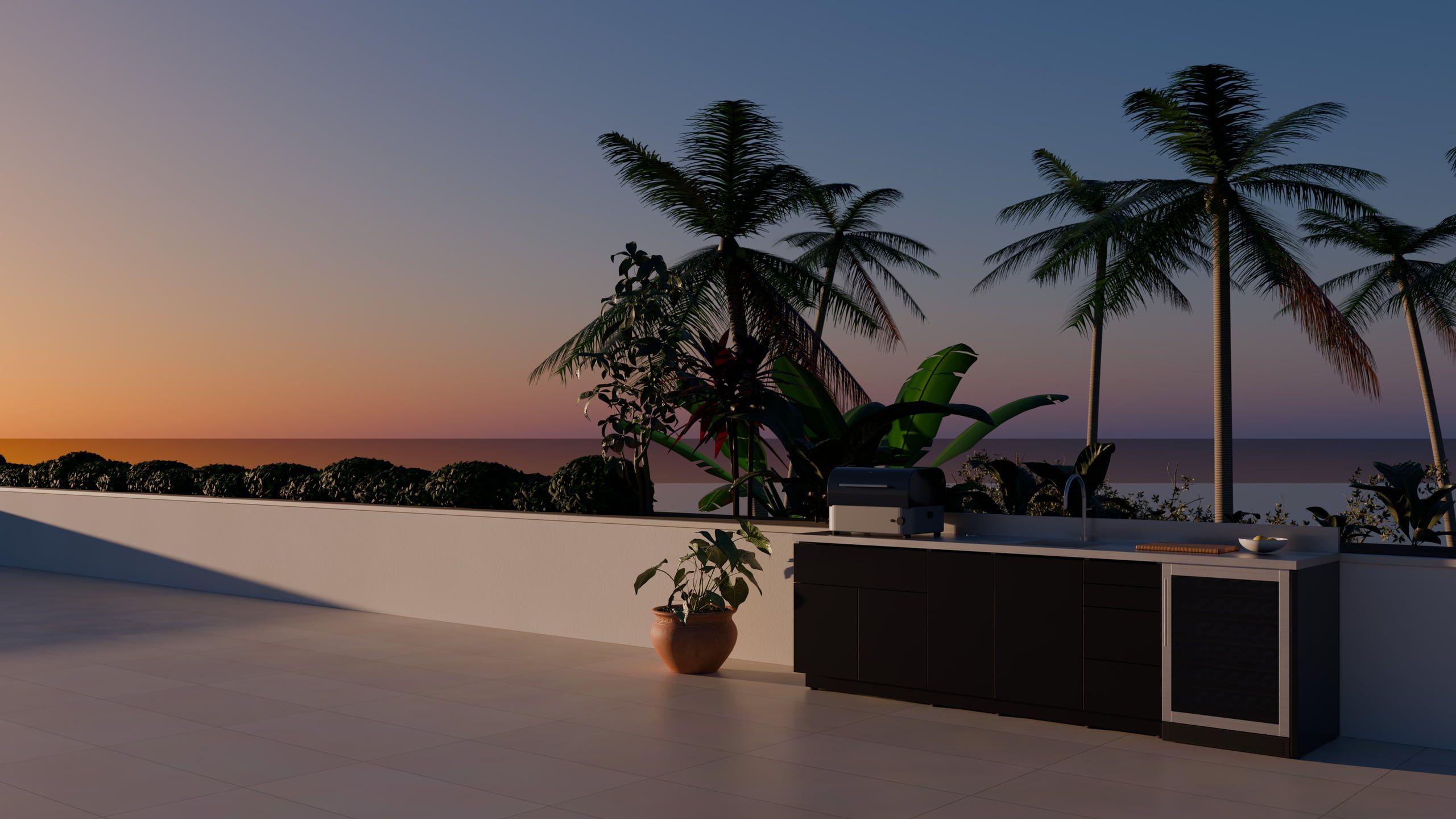
Colours shown on screen are indicative: each one is confirmed from a physical sample, in the light of your own terrace. A dark colour also heats up more in the sun than a light one, which matters for a kitchen that faces the afternoon sun.
How does Maison Barbet build its carcasses?
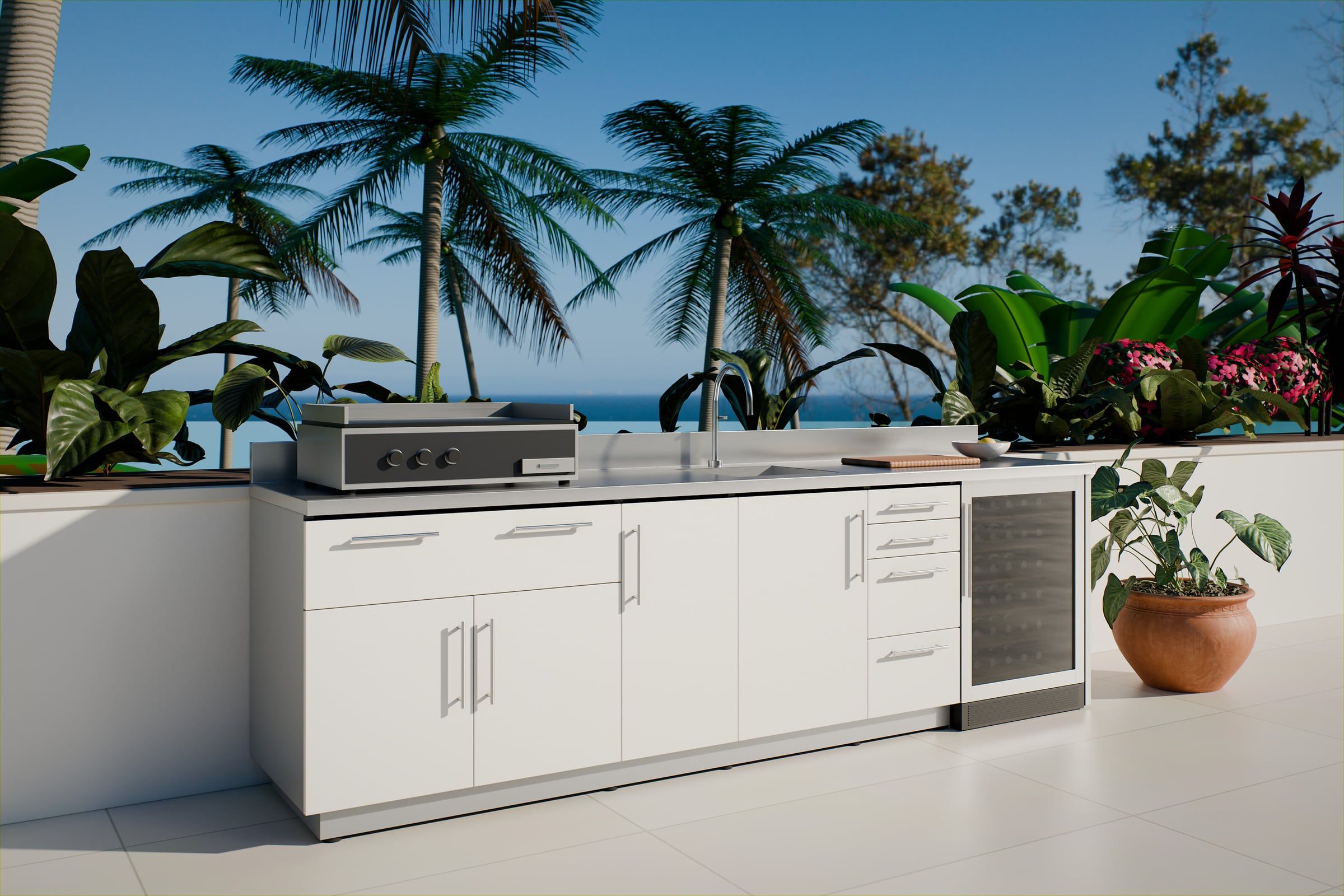
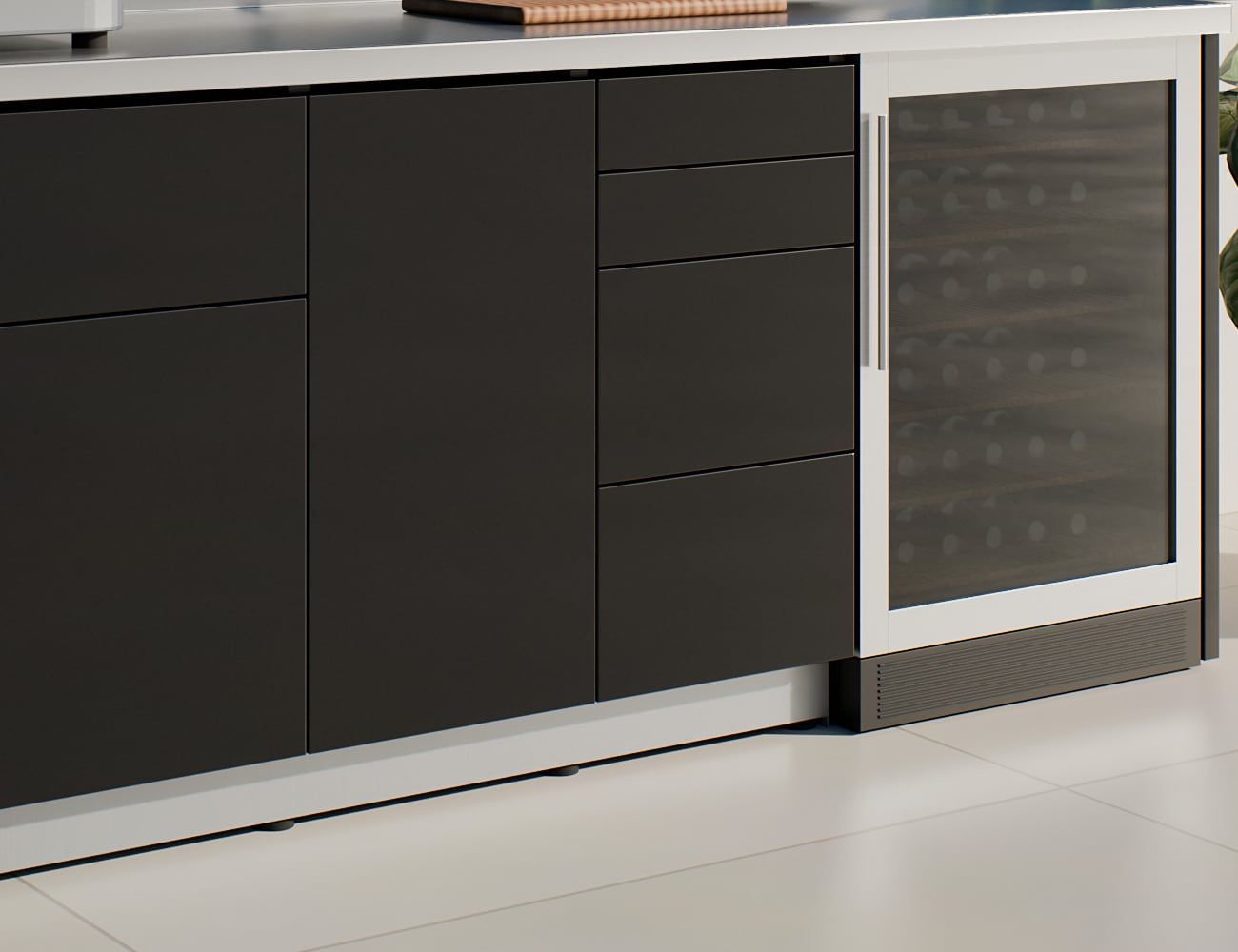
All three collections, Aube, Aurore and Crépuscule, share the same construction: carcasses and fronts in lacquered 316L stainless steel. The rest follows from the climate.
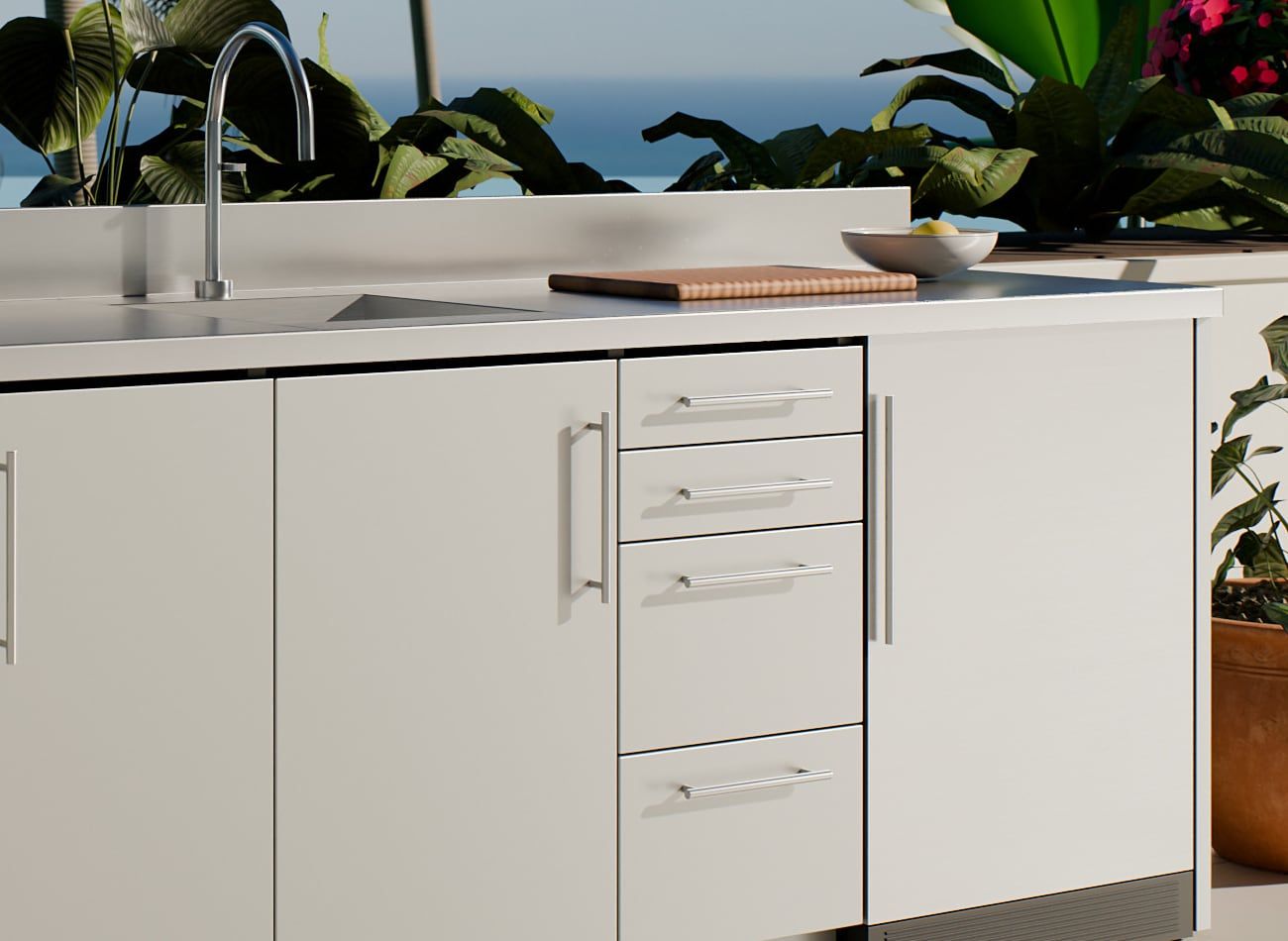
- Carcasses in 18 mm honeycomb panels faced with 316L stainless steel, and fronts in 316L stainless steel, lacquered in the colour of your choice.
- Soft-close hardware, for hinges and drawers alike.
- Adjustable feet that take up any unevenness in the terrace; on Aube, the worktop height is set at 900 mm ± 15 mm.
- A solid plinth, set back 50 mm on Aube, stopping 15 mm above the floor.
- A perforated carcass base, so that rain or washing water drains away rather than pooling.
- Islands fixed to the slab with four 316L stainless steel brackets.
The 15 mm gap beneath the plinth has a second role. Together with the perforated floor and the shadow gap under the worktop, it ventilates the gas bottle compartment without a single visible vent. The reasoning behind each choice is set out on the Materials & craft page.
What if you want the look of wood?
Choosing stainless steel does not mean giving up the look of wood. The colour chart includes eleven wood effects, from Pine to Ebony walnut by way of Golden oak, Red teak and Cherry. Crépuscule, whose character rests on the drawing of wood, draws on them naturally; Aube and Aurore can take them too.
Wood for the eye, stainless steel for the climate.
The other families in the chart run from Velvet white to Meteorite grey, and from Ink green to Metallic graphite. Colours are chosen from samples, and the carcass is discussed alongside the composition at the first meeting.
Frequently asked questions
Is a wooden outdoor kitchen suitable for the Caribbean?
Wood is possible, but it moves with humidity, swelling and shrinking in a way that strains joints and fronts. In a tropical climate it needs protection and regular upkeep. Chipboard, for its part, swells as soon as it gets wet. Maison Barbet has therefore left both out: its carcasses and fronts are made of lacquered 316L stainless steel.
Does 316L stainless steel rust by the sea?
316L stands up to salt better than common grades, thanks to the molybdenum it contains. It is not unalterable, however: in salty air it can develop light brown surface marks, especially on parts the rain does not rinse. Regular rinsing with fresh water limits them. On Maison Barbet kitchens, carcasses and fronts are lacquered as well.
Is a masonry outdoor kitchen preferable?
It depends on the project. A masonry kitchen is built on site, heavy and fixed; it needs waterproofing, a finish and separately chosen doors. A kitchen with a stainless steel carcass, such as those by Maison Barbet, is made to measure and then set on adjustable feet that take up any unevenness in the terrace. The two approaches meet different expectations.
Which colours suit a lacquered stainless steel outdoor kitchen?
Maison Barbet offers a chart of 30 colours, shared by its three collections: whites, greys, deep tones, metallics, a stone effect and eleven wood effects. The colours shown are indicative and are confirmed from a physical sample. Under the Caribbean sun, bear in mind that a dark colour heats up more than a light one.