




Design · 6 min read
Outdoor kitchen in the Caribbean: the questions to ask first
Designing an outdoor kitchen in the Caribbean starts with four questions: how you entertain and cook, what sun, trade winds, salt and rain do to your terrace, where water, gas and electricity arrive, and how much space you can give it. The answers then decide the materials, the layout (straight, corner or island) and the appliances. Colour comes last.
By Maison Barbet · Published · Updated
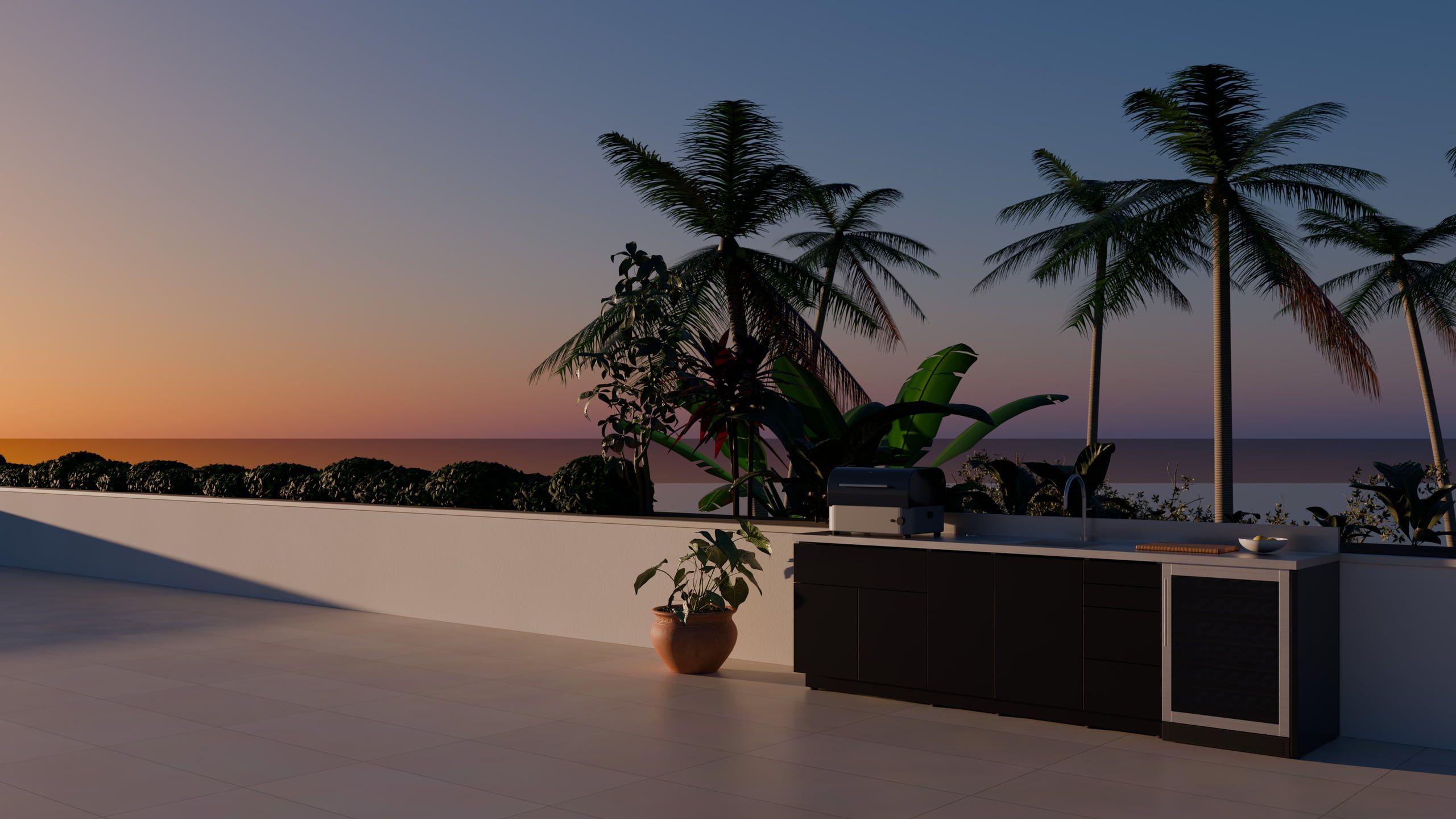
How do you entertain, and how do you cook?
An outdoor kitchen is a fixed set of cooking, preparation and storage units installed outside. Before any dimension, describe your evenings: dinner for two on a weeknight, a table of twelve on Sunday, or a rental villa whose guests may cook a great deal or hardly at all. The number of guests sets the length of worktop, the seating and the amount of refrigeration.
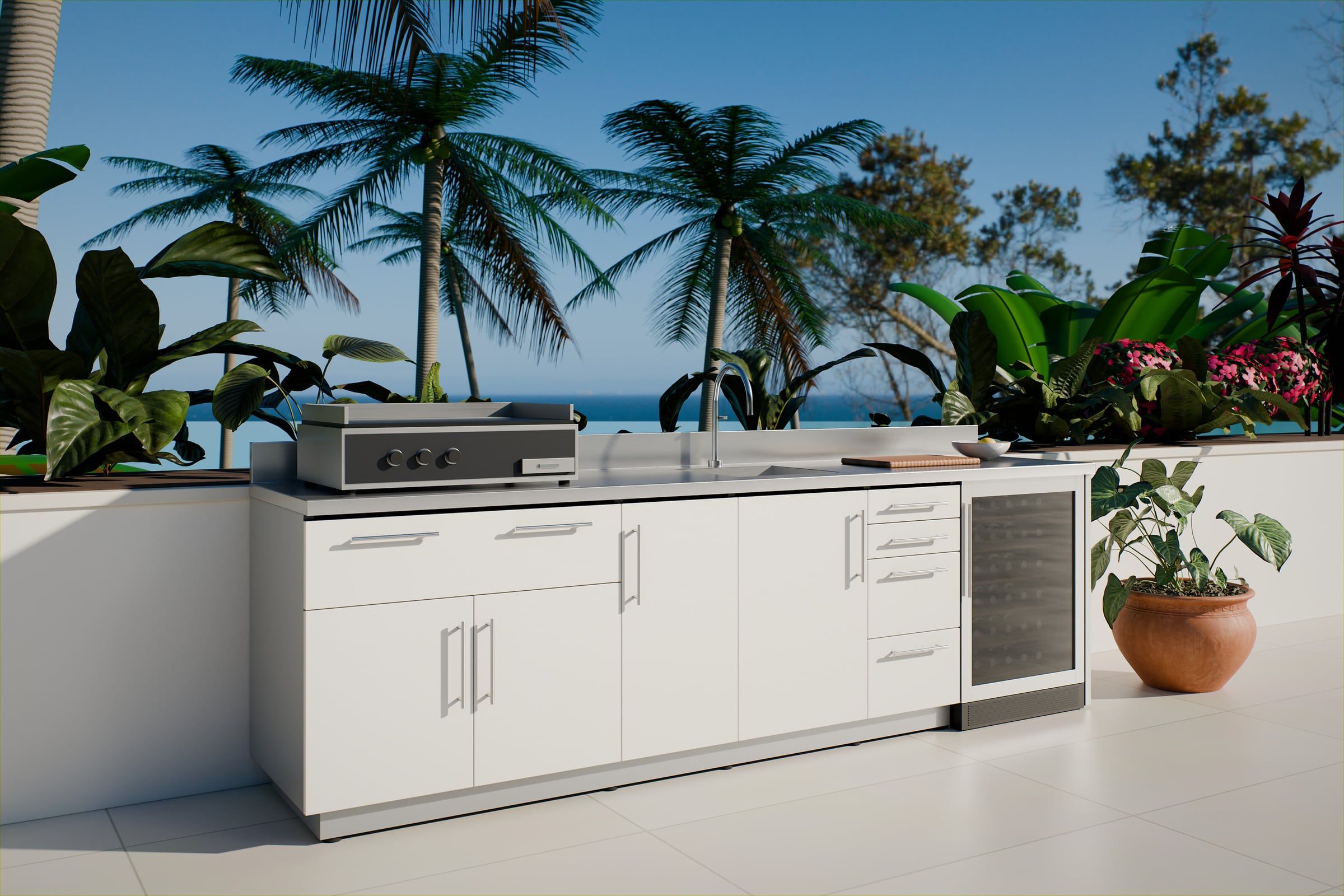
How you cook matters just as much. A plancha suits fish, shellfish and seared vegetables; a grill with a lid allows roasting and slower, covered cooking. The cooking area of Aube takes a freestanding grill or plancha up to 780 × 500 mm; Aurore has a built-in gas plancha, Crépuscule a five-burner built-in gas grill. Appliances are supplied by you or, as an option, by Maison Barbet. A sink, drawers and an under-counter fridge then save trips back to the house.
What do sun, trade winds, salt and rain say about your terrace?
Look at the terrace at the hour you intend to cook. A west-facing terrace takes the late-afternoon sun, just as guests arrive; in the tropics the midday sun stands high for much of the year, and walls then cast very little shade.
In the French Caribbean the trade winds blow mostly from the east to the north-east. Place the cooking area downwind of the table, so that smoke drifts away from your guests, and shelter the burners from a steady wind, which disturbs the flame. Salt depends on distance and exposure: a seafront terrace facing the wind receives far more sea spray than a sheltered one set back from the shore. Rain often comes in short, heavy showers, especially in the wet season, so the slab needs a fall that carries water away.
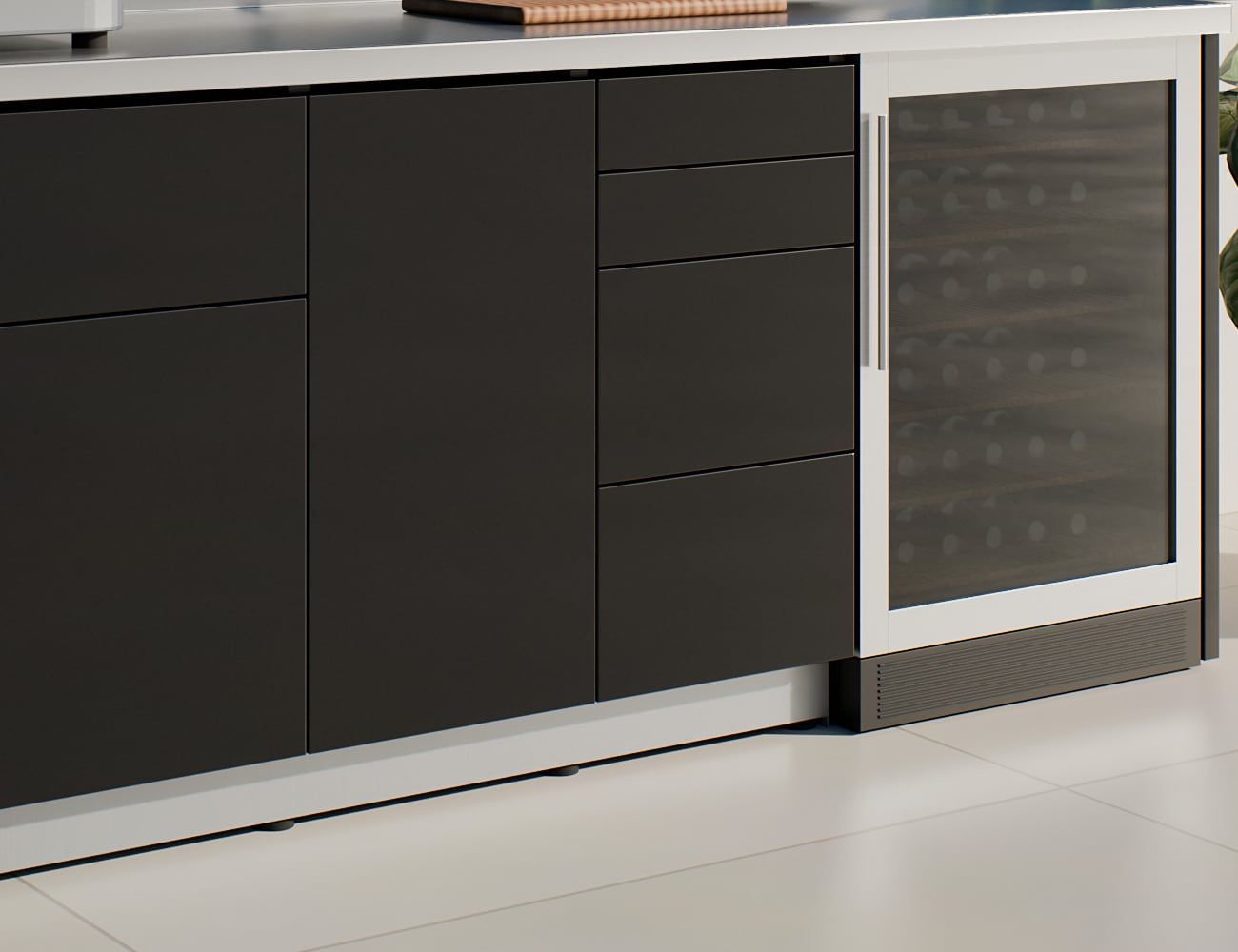
Then there is shade. A pergola, a roof or a shade sail protects the cook and limits how hot surfaces become: a dark finish heats up more in the sun than a light one, which matters when choosing from the 30-colour chart, from whites to deep tones.
Where do water, gas and electricity arrive?
Utilities are planned before the design. A sink needs a water supply and a drain; a fridge, lighting or a socket need an electrical line suited to outdoor use; a gas plancha or grill needs a bottle housed in a ventilated space. This work belongs to qualified professionals, following the regulations in force and the appliance manufacturers’ instructions. For a villa being built or renovated in Saint-Martin or Saint-Barthélemy, run ducts and pipes before the slab or tiling is laid.
On the kitchen side, the bottle compartment is ventilated from below, through a continuous 15 mm gap under the plinth and a perforated floor, and from above, through a shadow gap beneath the worktop; a double partition filled with rock wool separates it from the cooking area. On Aube, a built-in 16 A IP44 socket, protected against splashing water, is available as an option. At the first meeting we note the water supply and the gas and electrical connections.
Which materials suit the Caribbean climate?
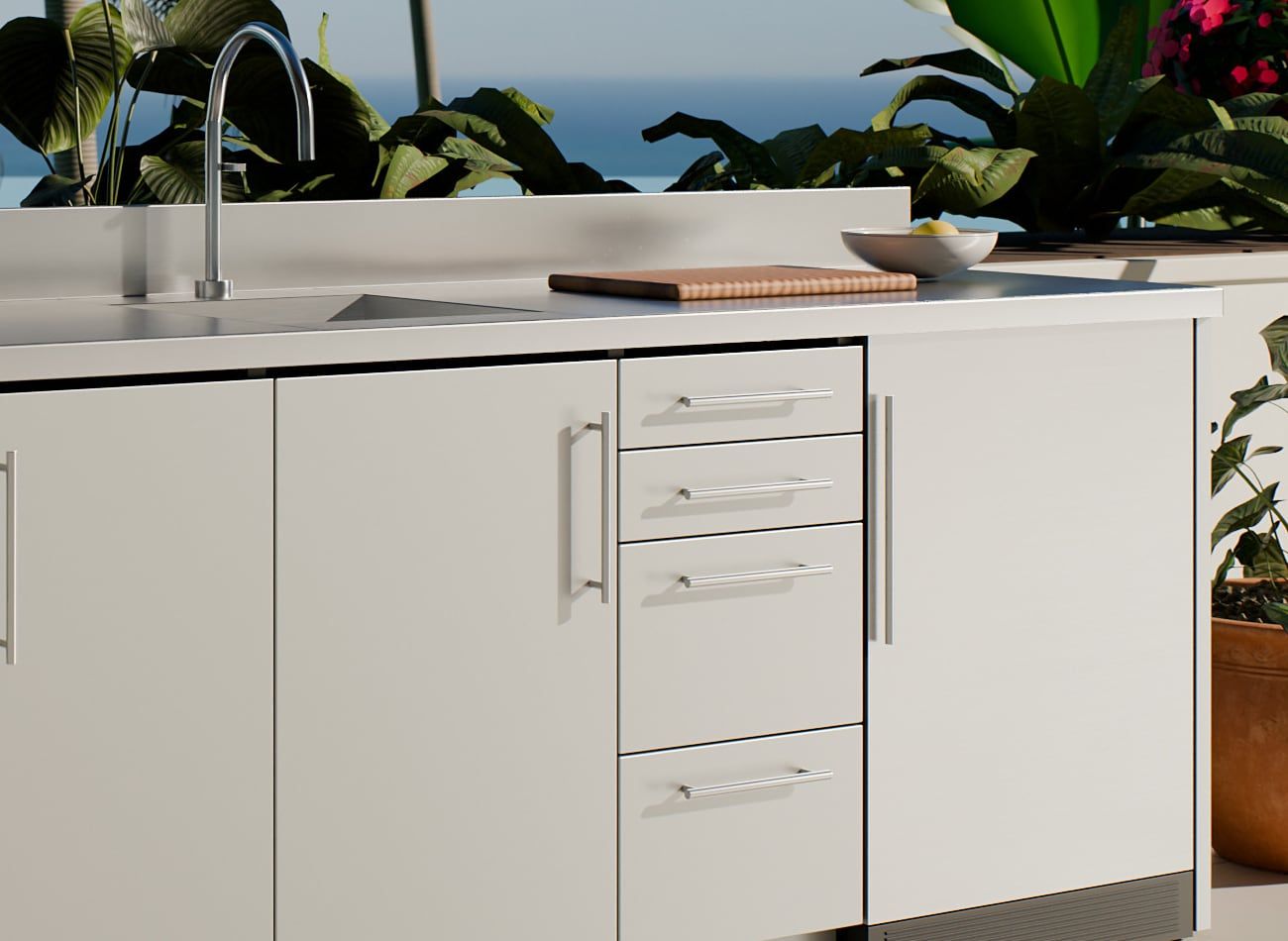
An outdoor kitchen is judged first by what it leaves out: no wood, no chipboard, nothing that can swell with humidity. All three Maison Barbet collections are built with carcasses and fronts in 316L stainless steel, lacquered in a shared chart of 30 colours, eleven of them wood effects. The hardware is soft-closing, for hinges and drawers alike.
For the worktop, Aube uses brushed 316L stainless steel, the molybdenum grade known as marine grade: molybdenum improves the steel’s resistance to chlorides, and so to salt, without making rinsing optional; sintered stone is offered as an option. Aurore and Crépuscule take a 12 mm sintered stone top, a mineral material pressed and then fired at high temperature, in 32 shades: marbles, stones, travertines and solids.
Lacquer colours and stone shades alike are indicative on screen and are confirmed from samples. Each material is described on the Materials & craft page.
Wood for the eye, stainless steel for the climate.
Straight, corner or island: which layout?
Every composition has a 900 mm worktop height; straight and corner kitchens are 650 mm deep. With no visible vents on the gas compartment, a kitchen can stand against a wall.
- Straight, along a wall or a balustrade: Aube in 1.70 m, 2.34 m or 2.84 m, or the three-metre Aurore 300.
- Corner, to spread tasks across two wings joined on site: Aube Angle (3.04 × 2.10 m) or Crépuscule Angle (3 × 3.08 m).
- Island, facing your guests: Aube islands are made to measure from 1.20 m to 3 m in 10 mm steps; the bar version seats three over 1.80 m.
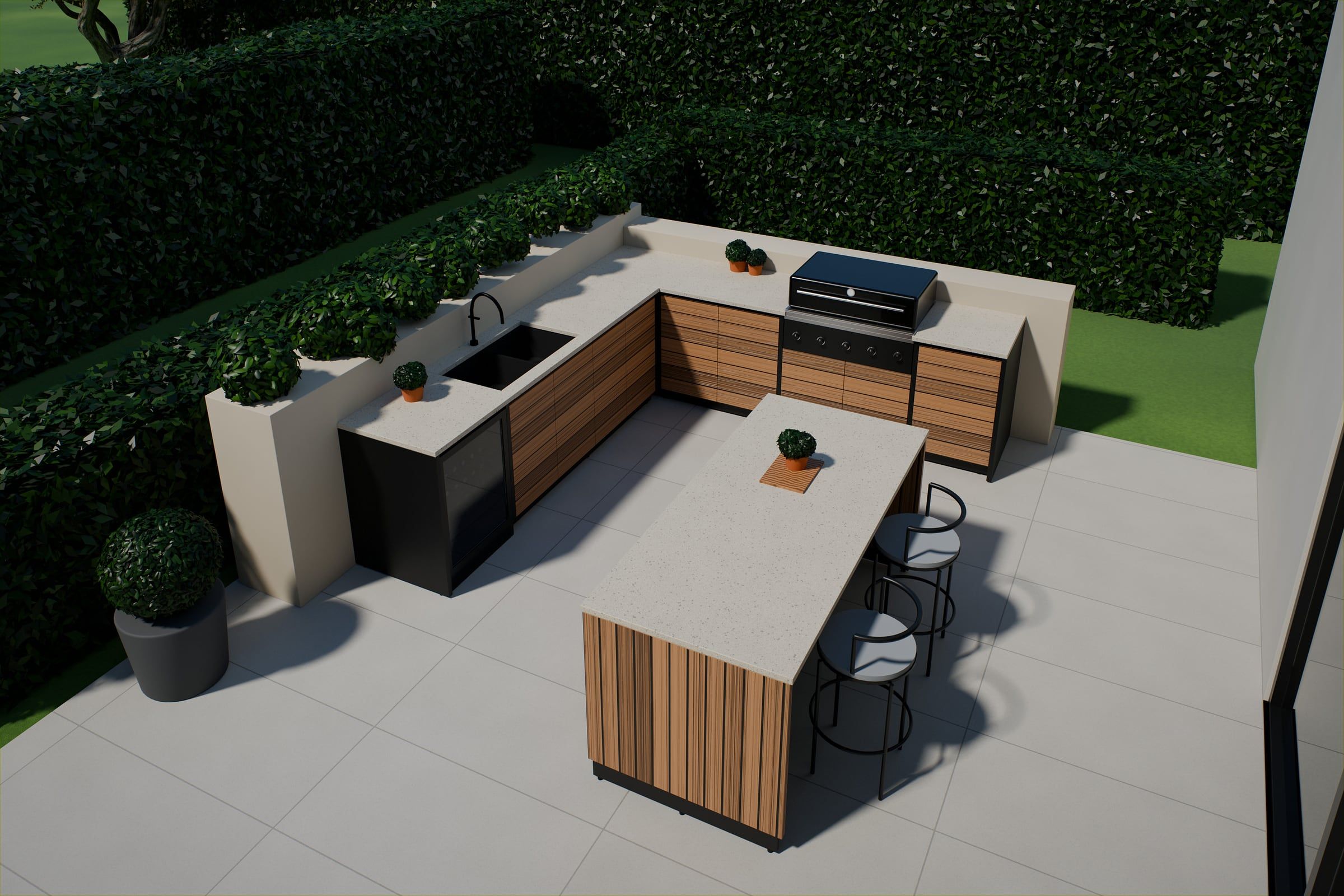
On a windy terrace an island has to be anchored: Maison Barbet islands are fixed to the slab with four 316L stainless steel brackets. Adjustable feet take up unevenness in the terrace; on Aube, the worktop height adjusts within ± 15 mm.
What budget, and how does the project unfold?
A Maison Barbet kitchen has no catalogue price: each one is quoted individually, according to the collection, layout, finishes, options and appliances chosen. Published dimensions are indicative and confirmed during the study. The bespoke process runs in six steps:
- Meeting: your terrace, how you live, orientation, winds, water and connections.
- Design: collection, composition and finishes, adapted to your space.
- 3D drawings: dimensioned drawings and a three-dimensional view, approved before manufacture.
- Manufacture: carcasses and fronts in lacquered 316L stainless steel, every part inspected.
- Installation: corner kitchens joined on site, islands fixed to the slab.
- Aftercare: we remain available after installation.
Maison Barbet works in Guadeloupe, Martinique, Saint-Martin and Saint-Barthélemy. Bring a few photographs of the terrace and its orientation to the first meeting: book an appointment.
Frequently asked questions
Which materials suit an outdoor kitchen in the Caribbean?
Materials chosen for humidity and salt: no wood or chipboard, which can swell. Maison Barbet uses carcasses and fronts in lacquered 316L stainless steel, with a worktop in 316L stainless steel, the molybdenum grade known as marine grade, or in 12 mm sintered stone. By the sea, regular rinsing with fresh water is still needed.
Should water, gas and electricity be planned before ordering an outdoor kitchen?
Yes. A sink needs a water supply and a drain, a fridge or a socket an electrical line suited to outdoor use, and a gas plancha or grill a bottle housed in a ventilated space. This work belongs to qualified professionals. Ducts and pipes are far easier to run before a slab is poured or tiles are laid.
How much does a Maison Barbet outdoor kitchen cost?
Each kitchen is quoted individually, according to the collection, layout, finishes and options chosen, and the appliances if you ask Maison Barbet to supply them. There is therefore no catalogue price. The quotation follows the study of your project, which begins with a first meeting, by appointment.
Does Maison Barbet work in Saint-Martin and Saint-Barthélemy?
Yes. Maison Barbet works in Guadeloupe, Martinique, Saint-Martin and Saint-Barthélemy. There is no showroom: the team works by appointment, in Martinique and Guadeloupe. For another Caribbean island, the question can be raised at the first appointment. On request, you receive dimensioned drawings and a three-dimensional view to approve before manufacture.